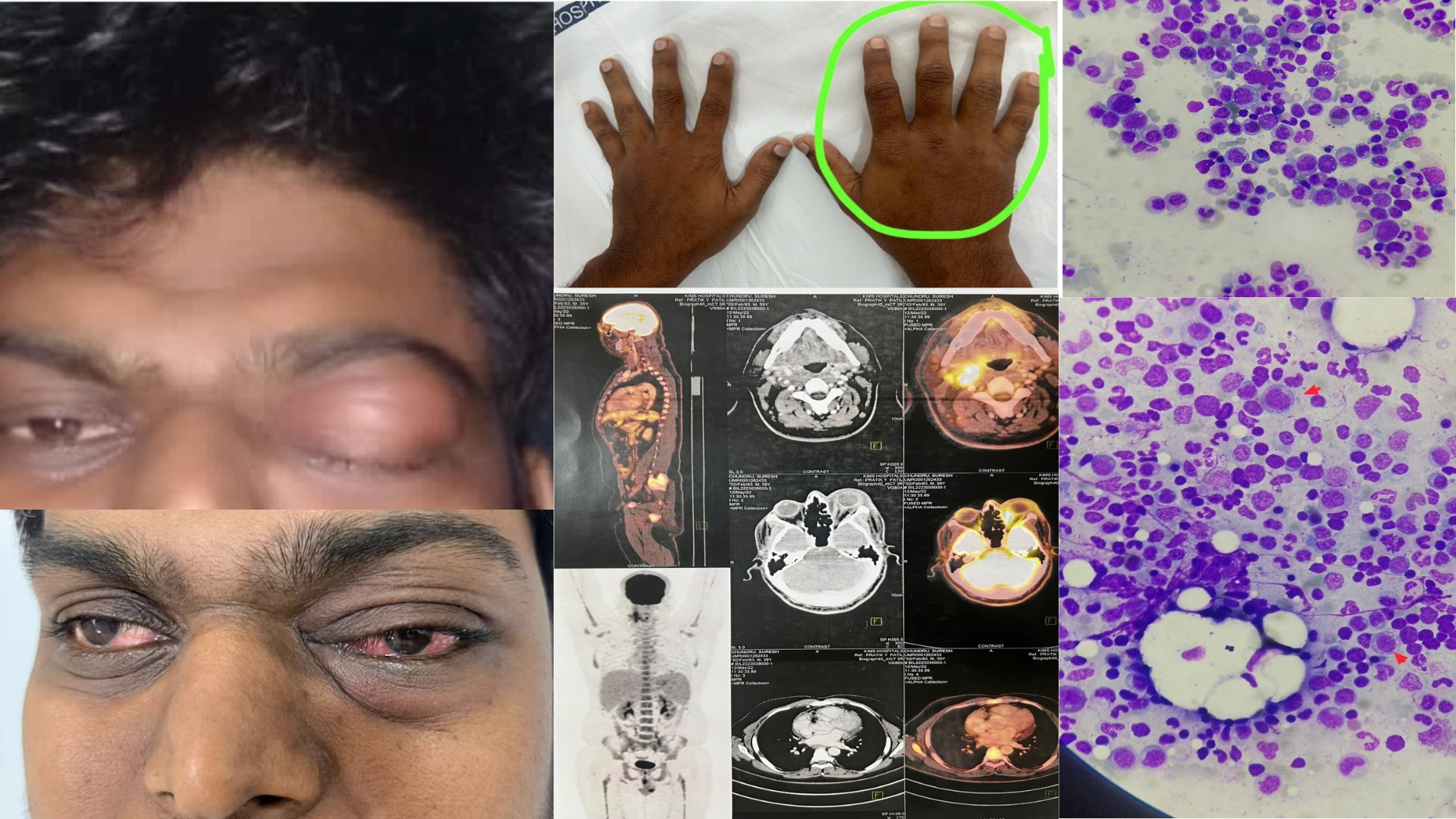
Every year, the ACR conducts a case-based image competition. Images are submitted for peer review. The winning images are displayed at ACR Convergence, and winners receive other benefits as well. In October 2025, annual meeting attendees voted on their favorite presentation, selecting the image case from South Asia, presented by Sarath Chandra Mouli Veeravalli, and making it the People’s Choice winner.
Dr. Veeravalli is the chief rheumatologist at Krishna Institute of Medical Sciences, Hyderabad, Telangana, India (http://www.rheumatology-india.com/profile.html).
The Case
A 39-year-old man presented with progressive dyspnea, erythematous leg nodules, recurrent fevers, weight loss, periorbital swelling and inflammatory arthritis, signs and symptoms he’d experienced starting in October 2021. Initial treatments for suspected pneumonitis and epididymo-orchitis showed partial responses. Positron emission tomography-computed tomography (PET-CT) revealed multi-system involvement, including his lungs, eyes, carotids, heart and bone marrow. Bone marrow biopsy showed erythroid precursors with cytoplasmic vacuoles. Given the persistent systemic inflammation and multi-organ involvement, VEXAS (vacuoles E1 enzyme X-linked auto-inflammatory somatic) syndrome was suspected. Genetic testing confirmed a UBA1 p.Met41Val mutation.
The patient was diagnosed with VEXAS syndrome—a recently recognized X-linked auto-inflammatory disorder—and is currently stable on low-dose corticosteroids and methotrexate.

VEXAS
Scientists first described VEXAS in late 2020.1,2 Affected individuals acquire pathogenic somatic mutations in the UBA1 gene, which makes the major E1 enzyme responsible for ubiquitylation, an important post-translational modification of peptides. The adult-onset condition is often refractory to treatment and sometimes fatal, occurring with a variety of hematologic and inflammatory features.
A new document from the ACR provides physicians with key guidance on the diagnosis and management of this rare condition.3
According to the guidance document, clinicians should start glucocorticoids for all patients with confirmed VEXAS and inflammatory manifestations. Glucocorticoid-sparing agents can be added as well, with some small studies and experience at expert centers showing potential benefits for anti-interleukin (IL) 6 or anti-IL-1 therapies, or Janus kinase (JAK) inhibitors.
Rheumatologists should coordinate with hematologists in the management of cytopenias and myelodysplastic syndromes (MDS). Allogeneic hematopoietic stem cell transplantation is a potential curative option for select patients. Azacitidine, a hypomethylating agent often used in certain blood cancers and in MDS, is another management option for hematologic manifestations.
Learn more: https://acrjournals.onlinelibrary.wiley.com/doi/10.1002/art.43287
References
- Hickman R. First ACR guidance statement for VEXAS released. The Rheumatologist. 2025 Dec 11. https://www.the-rheumatologist.org/article/first-acr-guidance-statement-for-vexas.
- Beck DB, Ferrada MA, Sikora KA, et al. Somatic mutations in UBA1 and severe adult-onset autoinflammatory disease. N Engl J Med. 2020 Dec 31;383(27):2628–2638.
- Mekinian AM, Georgin-Lavaille S, Ferrada MA, et al. American College of Rheumatology guidance statement for diagnosis and management of VEXAS developed by the international VEXAS working group expert panel. Arthritis Rheumatol. 2025 Aug 11. Online ahead of print. https://acrjournals.onlinelibrary.wiley.com/doi/10.1002/art.43287
The Rheumatology Image Library is a highly accessed teaching resource, and images from the ACR’s annual contest are added to it, helping keep it dynamic and current. Look for the Overall and Regional winners in future issues and on our website.