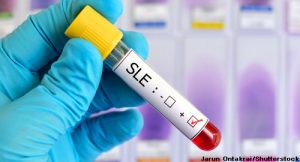
Saphnelo (anifrolumab-fnia) is a human IgG1κ, monoclonal antibody and type I interferon receptor antagonist.1 Type I interferons have a pathogenic role in systemic lupus erythematosus (SLE). Approximately 60–80% of adult patients with active SLE disease have elevated levels of type I interferon inducible genes. Anifrolumab-fnia binds to subunit 1 of the type I interferon receptor (IFNAR) with high specificity and affinity. This binding inhibits type I interferon signaling, thereby blocking the biologic activity of type I interferons.
Additionally, the medication induces internalization of IFNAR1, which reduces the levels of cell surface IFNAR1 agent for receptor assembly. Blocking receptor mediated type I interferon signaling inhibits interferon responsive gene expression, as well as downstream inflammatory and immunological activities. Inhibition of type I interferon blocks plasma cell differentiation and normalizes peripheral T cell subsets.
Status in the U.S. & EU
In July 2021, U.S. Food & Drug Administration approved intravenous (IV) anifrolumab-fnia for the treatment of adults with moderate to severe SLE receiving standard therapy (i.e., oral corticosteroids, antimalarial and/or immunosuppressants). The IV product is available as a 300 mg/2 mL vial that is further diluted and currently administered as a 30-minute infusion every four weeks.2
This October, in the EU, 120 mg of anifrolumab-fnia was recommended for approval as a self-administered, subcutaneous, pre-filled pen given weekly for adult patients with SLE in combination with standard therapy (i.e., oral corticosteroids, antimalarial and/or immunosuppressants).3 The Committee for Medicinal Products for Human Use of the European Medicines Agency based its recommendation for anifrolumab-fnia on interim results from the phase 3 TULIP-SC clinical trial (NCT04877691), which was recently presented during ACR Convergence 2025.4,5
The Research
In the study, 367 participants with SLE on standard therapy were randomized in a 1:1 ration to receive either a 120 mg dose of subcutaneous anifrolumab-fnia or placebo administered once weekly via a prefilled syringe. A planned interim analysis was conducted when the first 220 participants reached week 52. The primary end point was the reduction in disease activity measured using the British Isles Lupus Assessment Group based Composite Lupus Assessment (BICLA) at week 52. The BICLA requires improvement in all organs with disease activity at baseline with no new flares.5
Key secondary end points were the proportions of BICLA responders whose oral corticosteroid dose from week 40 through week 52 was ≤7.5 mg/day if baseline was ≥10 mg/day or less than or equal to baseline if baseline was <10 mg/day. The study also examined time to first BICLA response sustained to week 52, time to first flare and the proportion of patients who achieved SLE Responder Index (SRI-4) response.
Findings
At week 52, the primary end point was met, with 60.3% of patients who received anifrolumab-fnia achieving a BICLA response compared with 43.9% of patients who received placebo (difference [95% CI] = 16.5% [3.3–29.6%]; P=0.014). Also at week 52, the proportion of BICLA responders who met the oral corticosteroid dosing criteria and the proportion who achieved the SLE Responder Index response were greater numerically in the anifrolumab-fnia-treated group than in the placebo-treated group. Additionally, patients who received anifrolumab were also about two times more likely than those who received placebo to achieve a BICLA response sustained through week 52.
No new safety signals were identified in the study.
The study also includes an open-label extension period of 52 weeks for participants who completed the 52-week treatment period.
Conclusion
This clinical trial indicated that the subcutaneous administration of anifrolumab-fnia led to a statistically significant and clinically meaningful reduction in disease activity in patients with moderate to severe, active, autoantibody-positive SLE compared with placebo.
Michele B. Kaufman, PharmD, BCGP, is a freelance medical writer based in New York City and a pharmacist at New York Presbyterian Lower Manhattan Hospital.
References
- Highlights of prescribing information: Saphnelo (anifrolumab-fnia) injection. U.S. Food & Drug Administration. 2021 Jul.
- Biologics license application approval letter: Saphnelo (anifrolumab-fnia). U.S. Food & Drug Administration. 2021 Jul 30.
- Saphnelo subcutaneous self-administration recommended for approval in E.U. by CHMP for systemic lupus erythematosus [news release]. AstraZeneca PLC. 2025 Oct 17.
- Subcutaneous anifrolumab in adult patients with systemic lupus erythematosus (Tulip SC) [NCT04877691]. ClinicalTrials.gov. 2025 Oct 23.
- Manzi S, Bruce I, Morand E, et al. Efficacy and safety of subcutaneous anifrolumab in systemic lupus erythematosus: Interim analysis of a phase 3 randomized placebo-controlled study [abstract 1545]. Arthritis Rheumatol. 2025;77(suppl 9).