Can't Miss Webinar—Lupus Nephritis: The ACR Guideline in Practice

An official publication of the ACR and the ARP serving rheumatologists and rheumatology professionals

  • Conditions
    • Axial Spondyloarthritis
    • Gout and Crystalline Arthritis
    • Myositis
    • Osteoarthritis and Bone Disorders
    • Pain Syndromes
    • Pediatric Conditions
    • Psoriatic Arthritis
    • Rheumatoid Arthritis
    • Sjögren’s Disease
    • Systemic Lupus Erythematosus
    • Systemic Sclerosis
    • Vasculitis
    • Other Rheumatic Conditions
  • FocusRheum
    • ANCA-Associated Vasculitis
    • Axial Spondyloarthritis
    • Gout
    • Lupus Nephritis
    • Psoriatic Arthritis
    • Rheumatoid Arthritis
    • Sjögren’s Disease
    • Systemic Lupus Erythematosus
  • Guidance
    • Clinical Criteria/Guidelines
    • Ethics
    • Legal Updates
    • Legislation & Advocacy
    • Meeting Reports
      • ACR Convergence
      • Other ACR meetings
      • EULAR/Other
    • Research Rheum
  • Drug Updates
    • Analgesics
    • Biologics/DMARDs
  • Practice Support
    • Billing/Coding
    • EMRs
    • Facility
    • Insurance
    • Technology
      • Information Technology
      • Apps
    • QA/QI
    • Workforce
  • Opinion
    • Patient Perspective
    • Profiles
    • Rheuminations
      • Video
    • Speak Out Rheum
  • Career
    • ACR ExamRheum
    • Awards
    • Career Development
      • Education & Training
    • Certification
  • ACR
    • ACR Home
    • ACR Convergence
    • ACR Guidelines
    • Journals
      • ACR Open Rheumatology
      • Arthritis & Rheumatology
      • Arthritis Care & Research
    • From the College
    • Events/CME
    • President’s Perspective
  • Search

First ACR Guidance Statement for VEXAS Released

Ruth Jessen Hickman, MD  |  Issue: December 2025  |  December 11, 2025

VEXAS has a hetero­genous presentation and many potential hematologic and inflammatory aspects, including persistent elevation of inflammatory lab markers. Among the most common disease features outlined in the guidance document are dermatologic symptoms, such as neutrophilic dermatosis (Sweet syndrome), auricular or nasal chondritis, ocular involvement witsh periorbital swelling, ground­glass or nodular pulmonary infiltrates, leuko­cytoclastic vasculitis, thromboembolic disease and fever of unknown origin.

However, patients may also have less common inflammatory-type symptoms, with involvement of the peripheral nervous system, heart, kidneys and/or other types of skin manifestations.

ad goes here:advert-1
ADVERTISEMENT
SCROLL TO CONTINUE

“It’s really about understanding some of the particular features of the disease,” says Dr. Koster. “Not all patients are going to have auricular or nasal chondritis, for example, but if you have an older man with auricular or nasal chondritis, you need to have VEXAS in the differential.”

Macrocytic anemia is very com­monly, but not universally, present, especially in the earliest stages of the progressive disease. Dr. Koster also highlights the possibility of mono­cytopenia, an unusual finding in the setting of many other rheumato­logic diseases, which often display a reactive monocytosis instead. Thrombo­cytopenia and lymphopenia can also occur, as can vacuoles in early erythroid or myeloid precursor cells on bone marrow aspirate.

ad goes here:advert-2
ADVERTISEMENT
SCROLL TO CONTINUE

Some of these patients have previously received a rheumatic diagnosis, such as anti-neutrophil cytoplasmic antibody (ANCA) vasculitis or relapsing polychondritis. However, these patients usually have very atypical presentations, and they are often glucocorticoid-dependent and poorly responsive to standard treatments.

Management of VEXAS

A key thrust of the guidance document is the need for collaboration in both diagnosing and managing such patients. “It’s really a team-based approach, with rheumatologists and hematologists as two of the most important coordinators,” says Dr. Koster. “It’s critical to have both perspectives because rheumatologists are not as comfortable with cytopenias, and hematologists are not as comfortable with managing and monitoring inflammatory states.”
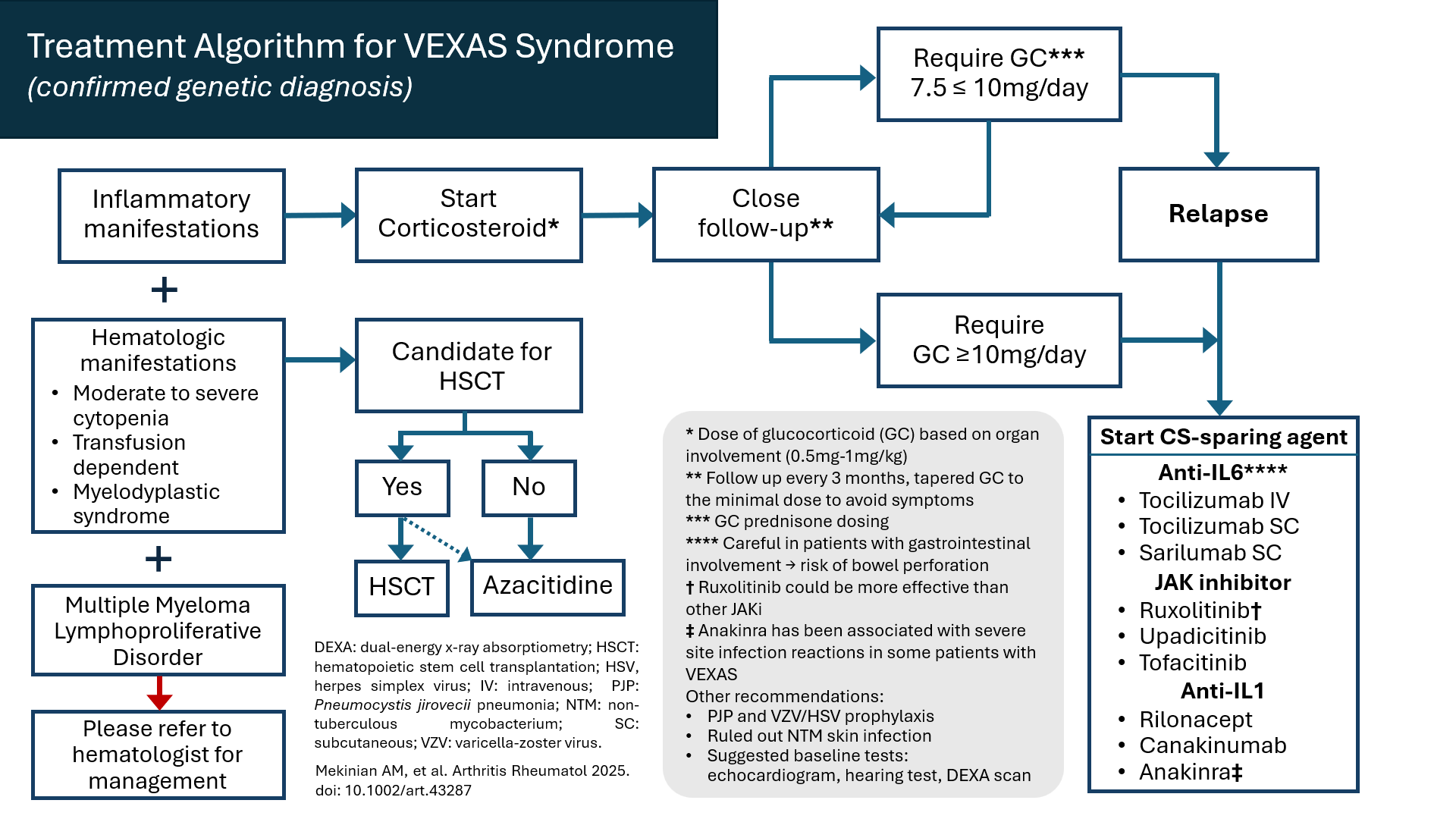
Click to enlarge.

Disease activity in VEXAS can be defined by inflammation or worsening bone marrow failure. Treatment (see Figure 1) must encompass controlling inflammation, treating bone marrow failure and addressing any secondary complications from treatment (e.g., glucocorticoid toxicities).

Clinicians should start glucocorticoids for all patients with confirmed VEXAS and inflammatory manifestations. Glucocorticoid-sparing agents can be added as well, with some small studies and experience at expert centers showing potential benefits for anti-interleukin (IL) 6 or anti-IL-1 therapies, or Janus kinase (JAK) inhibitors. These agents, targeting inflammatory pathways, appear to be more effective than conventional disease-modifying anti-rheumatic drugs or B cell-directed therapies. Although many centers are using anti-IL-6 agents as the first-line therapy, not enough evidence exists to establish that definitively.


Page: 1 2 3 4 | Single Page
Share: 

Filed under:Clinical Criteria/GuidelinesConditionsFrom the CollegeGuidanceOther Rheumatic ConditionsResearch Rheum Tagged with:myelodysplastic syndromesrelapsing polychondritisSweet's syndromeUBA1VEXASVEXAS syndrome

Related Articles

    No Longer as Vexing: The Role of Somatic Mutations in Rheumatic Diseases

    November 7, 2025

    At this ACR Convergence 2025 session, two experts discussed VEXAS & the role that genetic sequencing should play in the practice of a rheumatologist.

    Find Your Mentor in Medicine

    June 13, 2016

    Medicine has traditionally been an apprenticeship model. The most elemental and constructive method of passing on knowledge is the mentor–mentee relational experience. Mentorship encompasses not only the role of teacher, but also that of coach, role model, advisor and confidante. Matthew J. Koster, MD, rheumatology fellow and instructor in medicine, Mayo Clinic, Rochester, Minn., can…

    Dana Robochek / shutterstock.com

    VEXAS: A Newly Identified & Vexing Myeloid-Driven Inflammation

    December 14, 2020

    A large, international team of rheumatologists, geneticists, hematologists and other researchers has discovered a severe inflammatory syndrome linked to an acquired genetic mutation in the bone marrow of older men. The X-linked syndrome, they found, is caused by a somatic mutation in myeloid stem cells that hobbles the master regulator of a pathway tasked with…

    How 1 Rheumatology Patient Changed the History of a Disease

    November 10, 2024

    The story of one patient whose research participation helped establish VEXAS as a diagnosable condition.

  • About Us
  • Meet the Editors
  • Issue Archives
  • Contribute
  • Advertise
  • Contact Us
  • Copyright © 2026 by John Wiley & Sons, Inc. All rights reserved, including rights for text and data mining and training of artificial technologies or similar technologies. ISSN 1931-3268 (print). ISSN 1931-3209 (online).
  • DEI Statement
  • Privacy Policy
  • Terms of Use
  • Cookie Preferences