ACR Convergence 2025| Video: Rheum for Everyone, Episode 26—Ableism

An official publication of the ACR and the ARP serving rheumatologists and rheumatology professionals

  • Conditions
    • Axial Spondyloarthritis
    • Gout and Crystalline Arthritis
    • Myositis
    • Osteoarthritis and Bone Disorders
    • Pain Syndromes
    • Pediatric Conditions
    • Psoriatic Arthritis
    • Rheumatoid Arthritis
    • Sjögren’s Disease
    • Systemic Lupus Erythematosus
    • Systemic Sclerosis
    • Vasculitis
    • Other Rheumatic Conditions
  • FocusRheum
    • ANCA-Associated Vasculitis
    • Axial Spondyloarthritis
    • Gout
    • Lupus Nephritis
    • Psoriatic Arthritis
    • Rheumatoid Arthritis
    • Sjögren’s Disease
    • Systemic Lupus Erythematosus
  • Guidance
    • Clinical Criteria/Guidelines
    • Ethics
    • Legal Updates
    • Legislation & Advocacy
    • Meeting Reports
      • ACR Convergence
      • Other ACR meetings
      • EULAR/Other
    • Research Rheum
  • Drug Updates
    • Analgesics
    • Biologics/DMARDs
  • Practice Support
    • Billing/Coding
    • EMRs
    • Facility
    • Insurance
    • Technology
      • Information Technology
      • Apps
    • QA/QI
    • Workforce
  • Opinion
    • Patient Perspective
    • Profiles
    • Rheuminations
      • Video
    • Speak Out Rheum
  • Career
    • ACR ExamRheum
    • Awards
    • Career Development
      • Education & Training
    • Certification
  • ACR
    • ACR Home
    • ACR Convergence
    • ACR Guidelines
    • Journals
      • ACR Open Rheumatology
      • Arthritis & Rheumatology
      • Arthritis Care & Research
    • From the College
    • Events/CME
    • President’s Perspective
  • Search

New Rheumatoid Arthritis Risk Stratification Criteria Released

Ruth Jessen Hickman, MD  |  Issue: November 2025  |  November 10, 2025

The Criteria: Approach & Results

With this goal in mind, the expert committee pooled 10 different prospective, observational cohorts of people with arthralgias at risk for RA. None of the participants had clinically apparent inflammatory arthritis at the start of their respective studies. This specific pooled dataset and analysis also did not include patients who lacked symptoms of arthralgia but had other risk factors for RA. The pooled cohort, with data gathered from the Netherlands, Germany, Italy, Austria and the U.K., ultimately included almost 2,300 people.1

The primary end point was clinically apparent inflammatory arthritis in one or more joints, identified by physical exam. Dr. Deane points out that most rheumatologists would begin treatment for such patients if they saw them in clinic. Although this end point was technically defined in terms of inflammatory arthritis, due to inadequate study information to meet full classification criteria for RA in some cohorts, it’s assumed the majority would also clinically classify as having RA. Moreover, a second analysis with RA as an end point showed similar accuracy.

ad goes here:advert-1
ADVERTISEMENT
SCROLL TO CONTINUE

Ultimately, the main analysis included 24 potential clinical variables and serologic variables, although not every single variable was available in each individual—a challenge in combining cohort data. The team created a logistic regression model and a risk stratification model using the 24 clinical and serological variables and the primary end point outcome.

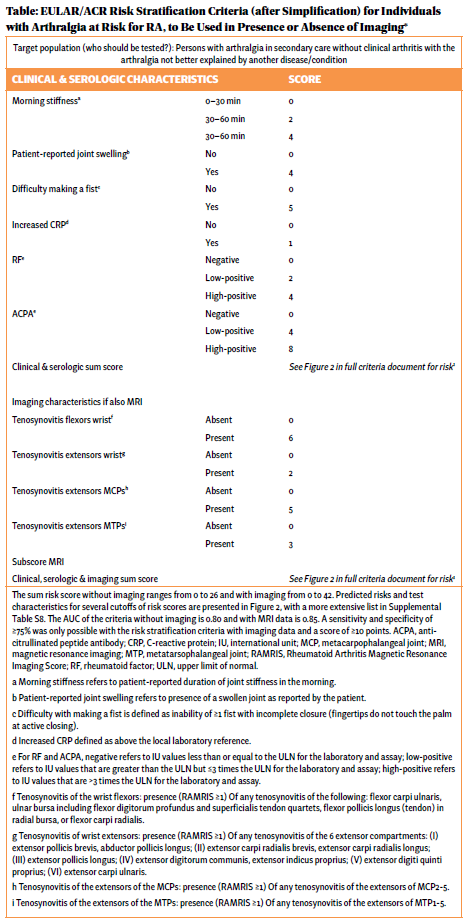
They used these findings to create a stratification method using six clinical and serological variables found to be strongly associated with the development of inflammatory arthritis. These were:

ad goes here:advert-2
ADVERTISEMENT
SCROLL TO CONTINUE
  1. Difficulty making a fist;
  2. Patient-reported morning stiffness;
  3. Patient-reported joint swelling;
  4. Increased C-reactive protein;
  5. Positive rheumatoid factor; and
  6. ACPA positivity.

Based on their respective predictive power, these were given different weights (e.g., four points for patient-reported joint swelling, five for difficulty making a fist, four points for low but positive ACPA, eight points for high-positive ACPA (see Table).
Click to enlarge.

The team also analyzed 10 ultrasound and 12 magnetic resonance imaging (MRI) variables, to see if imaging could improve discriminatory ability. Their specific analysis did not find that ultrasound further enhanced detection, but adding MRI improved the ability to accurately predict inflammatory arthritis.

Thus, a patient’s risk stratification criteria can be assessed just using clinical and serological parameters (with risk scores ranging from 0 to 26). Alternatively, adding additional MRI criteria, where available, can further improve accuracy (risk scores ranging from 0 to 42).

Page: 1 2 3 4 5 6 7 | Single Page
Share: 

Filed under:Clinical Criteria/GuidelinesConditionsEULAR/OtherGuidanceResearch RheumRheumatoid Arthritis Tagged with:ACPAarthralgiasC-reactive proteinearly RAPreclinical Rheumatoid ArthritisRA Resource CenterRheumatoid FactorRisk Factorsrisk stratification

Related Articles
    Rheumatoid Arthritis Research Provides New Insights on Risk Factors, Identification Tools, Intervention

    Rheumatoid Arthritis Research Provides New Insights on Risk Factors, Identification Tools, Intervention

    October 11, 2016

    Established wisdom holds that patients with rheumatoid arthritis (RA) will fare better if their disease is diagnosed as early as possible, and treatments with disease-modifying drugs are started before inflammation can do more damage to joints and tissue. Usually, early diagnosis means spotting the clinical signs of disease, but new research tells us more about…

    The Key to Early Rheumatoid Arthritis

    September 1, 2010

    The conundrum of classification versus diagnosis

    Updates in Ultrasound for Rheumatology 2024

    November 10, 2024

    It’s an exciting time for ultrasound in rheumatology, & it’s never too late to learn. Whether you’re just starting fellowship or have been practicing for decades, there’s a place for ultrasound in your practice.

    Désirée Van Der Heijde, MD, PhD, a Key Driver of Treatment Advances

    May 8, 2012

    Dr. van der Heijde learned early in her career that serendipity often plays a role in clinical research and treatment advances.

  • About Us
  • Meet the Editors
  • Issue Archives
  • Contribute
  • Advertise
  • Contact Us
  • Copyright © 2025 by John Wiley & Sons, Inc. All rights reserved, including rights for text and data mining and training of artificial technologies or similar technologies. ISSN 1931-3268 (print). ISSN 1931-3209 (online).
  • DEI Statement
  • Privacy Policy
  • Terms of Use
  • Cookie Preferences