For academic health centers or multi-specialty groups, the new RISE simplifies connectivity to EPIC and Cerner/Oracle electronic health records (EHRs), and provides opportunity for rheumatology-specific specialty quality reporting versus ACO reporting. “RISE enables you to know within 30 seconds if you are on track or should consider reviewing your current quality performance,” he said, adding that the new Analytics Dashboard can offer insights and includes longitudinal, comparator and detailed views of your data across your department, among other providers and peers, and other benchmarks. “In the future, RISE is expected to provide Centers of Excellence certification opportunities,” Mr. Tack added.
For researchers, the new registry will contain patient-level clinical data on more than 4 million patients and more than 41 million patient encounters. Basically, it will include data on virtually every rheumatic disease, including rare ones. “The RISE database is now a research-caliber database and will soon be tokenized, allowing RISE to be linked with other tokenized data sets to provide comprehensive patient-journey insights,” he said.
According to Dr. Bartels, additional benefits include the ability to create and validate new quality measures and other grant activities, such as the CDC lupus grant work. She also said the new RISE gives large health systems new specialty reporting options, which is important given that each ACO cycle increases the challenges to save beyond the prior period. In addition, she said RISE participation will be a way to benchmark large systems for recognition programs for disease-specific and overall centers of excellence.
“The new chapter of RISE will allow the ACR to lead the way into being a learning health specialty that delivers on the ACR promise to help providers so they can help their patients,” she said.
It’s About Connectivity
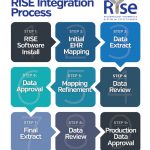
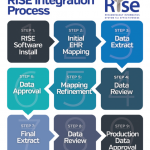
Mr. Voccola provided more details on the design and ease of use of the new registry. He said the RISE onboarding experience is quick, needing only the Taxpayer Identification Number (TIN) for your organization, an authorized signer for your organization and an EHR vendor name and software version. For each participating clinician, an NPI, email address and ACR member ID is needed.
Once you get through the front door, he said, the Quality Measures dashboard will light up with new EHR data in two ways. First, if your practice uses, for example, NextGen, the new registry can pre-integrate with the EHR and, once the practice joins, all data automatically goes into RISE. He said it takes IQVIA about 8 hours to get a practice connected and identifying a roster of patients to share in the registry.