Early Recovery: As Advertised
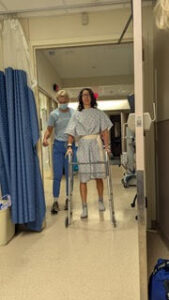
Dr. Shapiro used a walker for balance and a belt in case of falls when walking up stairs.
The first two weeks after surgery mirrored what my surgeon told me to expect: pain, swelling and nearly complete dependence on my fiancé Krishna.1 Range of motion at the hip was limited and painful, so reaching anything that wasn’t directly in front of me wasn’t on the menu. I needed a walker for balance, and Krishna had to tie a belt around my waist to safeguard against falls on stairs (see Figure 1).
For two weeks, Krishna brought me anything and everything I wanted while I was sedentary on the couch. He washed my legs in the shower because I couldn’t reach them—and even shaved them. He put on my socks and underwear. I couldn’t swing my legs in or out of bed, so he lifted them up for me—morning, evening and in the middle of the night when I had to pee. Some nights, I’d wake up screaming in post-op pain. He’d find my pain medications and hold me until I fell back asleep. He didn’t complain once.2
Five days after surgery, my leg looked more swollen than before, and I panicked. All I could think about was a deep vein thrombosis, and at my request, a Doppler ultrasound was ordered.
“How many days ago was your surgery?” the ultrasound tech asked, looking puzzled.
“Five,” I said, sheepishly. “I’m a physician. I just—know too much. Please humor me.”
He smiled gently and nodded.
The scan was negative, and the peace of mind that provided was priceless.
Later Recovery: WTF
Then came the part of recovery that no one told me about—not because of oversight, but because it’s impossible to explain or understand unless you’ve experienced it yourself.
Every day, a new part of the left side of my body hurt. Some days my left knee throbbed. Some days, my incision burned. Some days, my lower back ached on the left side. At one point, I could barely walk due to foot pain. It felt like there was a piece of glass stuck in my foot, although a podiatrist confirmed that was not the case. I remember thinking, “I had a hip replacement, not a leg replacement. Why is everything falling apart?”
Eventually, I figured out what I was experiencing: a complete recalibration between my brain, nerves and musculoskeletal system. For years, my body had compensated for hip dysplasia and OA by working with what was available and creating its own movement strategies. Suddenly, with a brand new, normal hip joint, none of those strategies made sense. I was loading my leg differently from top to bottom, and my body was freaking out. Things were going to take some getting used to.
The pain was annoying, but if I’m honest, pain had nothing on my anxiety and depression. “What if the surgery was all for nothing? What if I never get back to training? What if my body never feels normal again?” My thoughts ricocheted without rest, a spin cycle of doubt, dread, sadness and boredom.
I wanted to be in the gym, out and about, dancing, traveling—living. I wanted to feel normal again. But it was going to take time. It took physical therapy and psychotherapy to get me through this process.
3 Months Post-Op: Colorado
Around three months post-op, Krishna and I went to the Colorado mountains to hike and bike. I worried it was too soon but needed to get out of the Austin heat.
My gluteus medius, one of the primary stabilizers of the hip, had effectively gone offline after surgery. For months, I could barely activate it—an experience that was both medically fascinating and personally demoralizing. But with dedicated physical therapy, my glute slowly woke up. My gait became less clunky, and my range of motion improved. I began to trust my left side again.
Our hikes weren’t graceful, but they were doable. The pain wasn’t gone, but it was manageable. More importantly, it was the right kind of pain—the ache of reconditioning rather than joint destruction.
6 Months Post-Op: The Himalayas
Before surgery was even on the table, Krishna and I had planned a month-long Himalayan adventure to Bhutan and Nepal. And I was not going to miss it. When time for the trip came, I didn’t feel normal by any stretch, but I felt capable.
While he set off on an off-road dirt bike adventure with some friends, I headed into the Annapurna Conservation Area for a six-day trek. I arranged for a private guide so we could hike at a pace that respected my hip’s limits. As someone who once cranked out high-mileage days without blinking, the humility of planning around my body’s vulnerabilities was new and uncomfortable, but necessary.
We started slowly, and I listened to my body instead of pushing through pain the way I used to. By the end of day 1, I felt great, and I sat down with my guide to rewrite the trek itinerary.
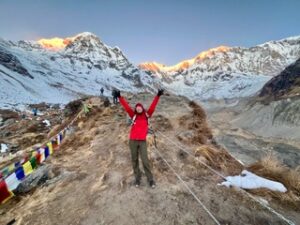
Six months post-op: Sunrise at Annapurna Base Camp, Nepal.
Not only did we reach Annapurna Base Camp early, but we added an extra 30 miles to the trek (see Figure 2). When all was said and done, we had hiked 60 miles in six days, mostly uphill. I felt strong. I felt powerful. I felt like myself.
Hip Replacements at 14,000 Feet
One night while eating dinner in a Nepali teahouse, I chatted with a fellow solo trekker from India. When he learned I was a rheumatologist, his face lit up.
“I have ankylosing spondylitis,” he said incredulously.
Later, I shared that I had recently gotten a hip replacement.
“I don’t believe it,” he said. “I’ve had two myself, and we’re both here doing this trek.”
We summitted the same morning and high-fived each other as the sun rose over Annapurna’s jagged peaks. It felt incredible to share that moment with someone who truly understood what I had gone through to get there.
Hope
Now, seven months post-op, I feel better than I have in years. I’m still working to regain full range of motion in my hip, but the pain that once dominated my days is gone. My mood is bright, I’m back in the gym, and I feel hopeful.
In the past, I have reassured my arthritis patients that there’s a day in the future that they will feel better than they feel now, but it will take time. This statement is true. But after this experience, I’ve edited my approach.
Now, I tell them that recovery isn’t linear. As your body heals, some days may feel more like chaos than progress and a lot of it won’t make sense. This is normal. And I them that I’ll be here to hold their hand through it all.
At some point, I know I’ll need surgery on my right hip for dysplasia and OA, too. But next time, I will know what’s wrong, and I will know what to expect. Recovery won’t be linear. There will be pain, and there will also be chaos. And in due time, there will be healing.
(Author’s note: Spoiler alert! Krishna proposed a few months after my surgery. This experience is one of thousands of reasons I’m marrying the guy.)
Samantha C. Shapiro, MD, is a clinician educator who is passionate about the care and education of rheumatology patients. She writes for both medical and lay audiences and practices telerheumatology.