ACR Convergence 2025| Video: Rheum for Everyone, Episode 26—Ableism

An official publication of the ACR and the ARP serving rheumatologists and rheumatology professionals

  • Conditions
    • Axial Spondyloarthritis
    • Gout and Crystalline Arthritis
    • Myositis
    • Osteoarthritis and Bone Disorders
    • Pain Syndromes
    • Pediatric Conditions
    • Psoriatic Arthritis
    • Rheumatoid Arthritis
    • Sjögren’s Disease
    • Systemic Lupus Erythematosus
    • Systemic Sclerosis
    • Vasculitis
    • Other Rheumatic Conditions
  • FocusRheum
    • ANCA-Associated Vasculitis
    • Axial Spondyloarthritis
    • Gout
    • Lupus Nephritis
    • Psoriatic Arthritis
    • Rheumatoid Arthritis
    • Sjögren’s Disease
    • Systemic Lupus Erythematosus
  • Guidance
    • Clinical Criteria/Guidelines
    • Ethics
    • Legal Updates
    • Legislation & Advocacy
    • Meeting Reports
      • ACR Convergence
      • Other ACR meetings
      • EULAR/Other
    • Research Rheum
  • Drug Updates
    • Analgesics
    • Biologics/DMARDs
  • Practice Support
    • Billing/Coding
    • EMRs
    • Facility
    • Insurance
    • Technology
      • Information Technology
      • Apps
    • QA/QI
    • Workforce
  • Opinion
    • Patient Perspective
    • Profiles
    • Rheuminations
      • Video
    • Speak Out Rheum
  • Career
    • ACR ExamRheum
    • Awards
    • Career Development
      • Education & Training
    • Certification
  • ACR
    • ACR Home
    • ACR Convergence
    • ACR Guidelines
    • Journals
      • ACR Open Rheumatology
      • Arthritis & Rheumatology
      • Arthritis Care & Research
    • From the College
    • Events/CME
    • President’s Perspective
  • Search

ACR Releases New Guideline for Management of SLE at ACR 2025

Mithu Maheswaranathan, MD  |  Issue: December 2025  |  November 14, 2025

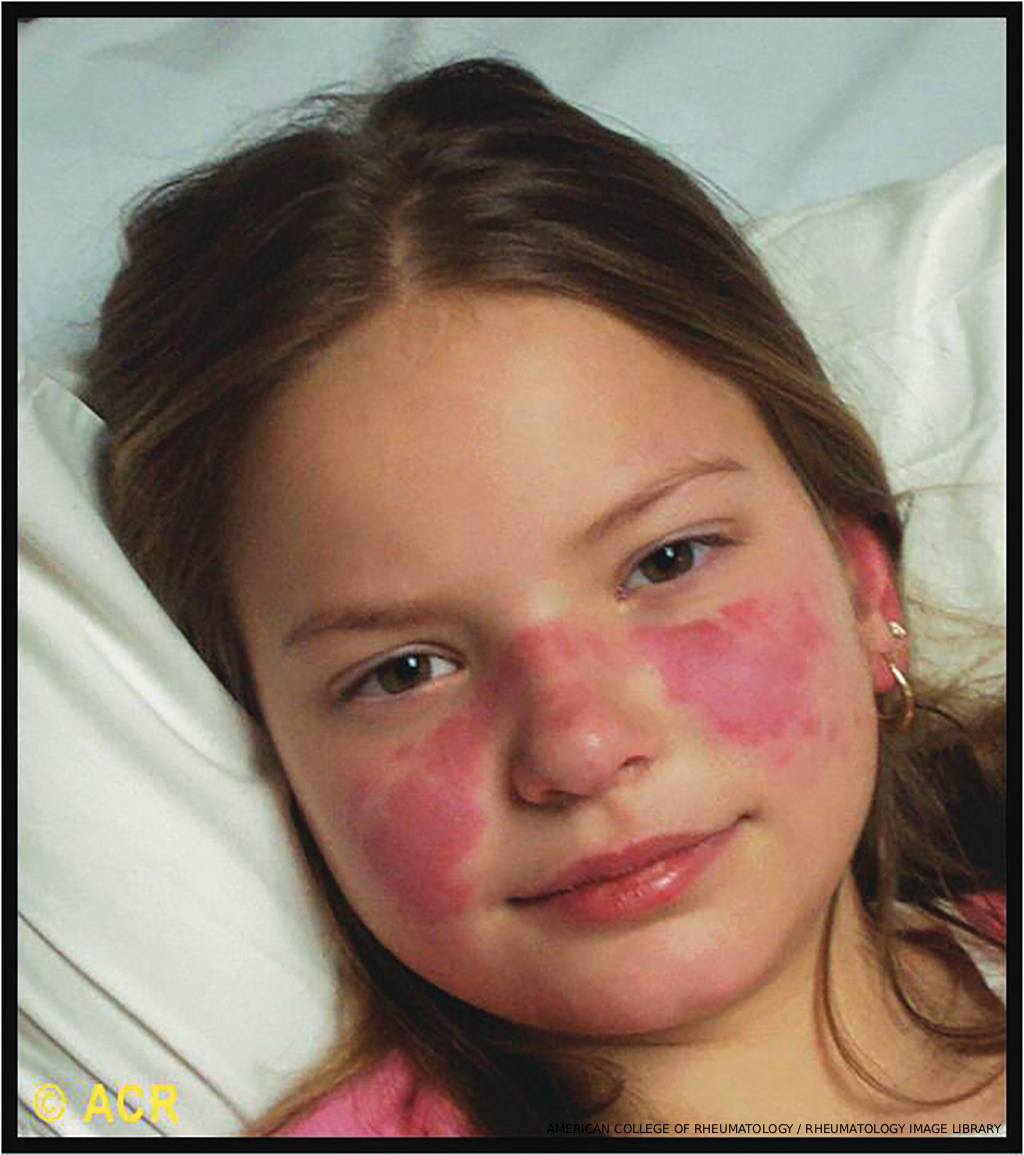
This young girl shows the

characteristic malar rash

seen in lupus. The rash

[mobile-ad name="Advert 1"]

tends to spare the eyelids

and nasolabial folds. (Click to enlarge.)

ad goes here:advert-2
ADVERTISEMENT
SCROLL TO CONTINUE

CHICAGO—At ACR Convergence 2025, the new 2025 ACR Guideline for the Treatment of Systemic Lupus Erythematosus (SLE) was unveiled.1

Guideline Development & Key Recommendations

Lisa Sammaritano, MD, professor of clinical medicine at Weill Cornell Medical College and the Hospital for Special Surgery, New York, kicked off the session by explaining the guideline development process.

The guideline was last published in 1999, and lupus treatment has significantly evolved since that time, including the introduction of new biologic therapies, belimumab and anifrolumab, approved by the U.S. Food & Drug Administration (FDA).

The process involved scoping articles, developing 52 broad PICO [patient/population/problem, intervention, comparison, outcome] clinical questions, conducting a literature review (over 10,000 articles reviewed with 63 references selected) and evaluating the evidence using the GRADE (grading of recommendations assessment, development and evaluation) process.

Dr. Sammaritano

“Recommendations were listed as strong or conditional, based on the level of evidence and certainty that benefits outweigh harms,” Dr. Sammaritano said. “There was also input from a patient panel discussion.”

Some limitations in scope included not addressing recommendations for diagnosis of SLE or broader, less well-understood issues, such as type 2 SLE, mental health and SLE-associated comorbidities, including bone health, cardiovascular disease or malignancy screening.

“For glucocorticoids, we urge prompt use to obtain rapid control of inflammation using the lowest dose for the shortest duration, and tapering as soon as possible to limit toxicity,” Dr. Sammaritano stated.

Dosages for hydroxychloroquine (HCQ) were also discussed. “All patients should be treated with hydroxychloroquine, unless contraindicated, and continued indefinitely even if in sustained remission,” Dr. Sammaritano said. Although the long-term goal is to maintain a daily dose of less than or equal to 5 mg/kg, the guideline notes short courses of higher doses of hydroxychloroquine (5–6.5 mg/kg/day) may be necessary at initiation of treatment to maintain disease control or during pregnancy.

All organ-specific recommendations were noted to be conditional.

Treating Lupus Serositis

Ali Duarte-Garcia, MD

Dr. Duarte-Garcia

Ali Duarte-Garcia, MD, MSc, assistant professor of medicine at the Mayo Clinic College of Medicine and Science, Rochester, Minn., discussed how to apply the guideline to treat lupus serositis. Lupus serositis refers to inflammation of serosal membranes, including pleuritis and pericarditis. Up to 43% of patients experience pleuritis during their disease course.2

Page: 1 2 3 4 5 6 | Single Page
Share: 

Filed under:ACR ConvergenceClinical Criteria/GuidelinesConditionsGuidanceMeeting ReportsSystemic Lupus Erythematosus Tagged with:ACR Convergence 2025BiologicsClinical Practice GuidelinesLupussystemic lupus erythematosus (SLE)

Related Articles

    Systemic Lupus Erythematosus: A Complex, Multi-Challenging Disease

    November 26, 2024

    Reviewing the research presented at ACR Convergence 2024.

    Lupus often presents with a butterfly rash.

    Top 12: Research in Systemic Lupus Erythematosus at a Glance

    November 18, 2021

    Dr. Pisetsky’s picks for the top research in lupus presented at ACR Convergence 2021.

    T Cells in Systemic Lupus Erythematosus

    August 1, 2011

    Progress toward targeted therapy

    Difficult-to-Treat Lupus: When & How to Use New Therapies

    July 21, 2022

    Clinicians have numerous treatment options for SLE; in a EULAR 2022 session, some of the newer therapies were reviewed.

  • About Us
  • Meet the Editors
  • Issue Archives
  • Contribute
  • Advertise
  • Contact Us
  • Copyright © 2025 by John Wiley & Sons, Inc. All rights reserved, including rights for text and data mining and training of artificial technologies or similar technologies. ISSN 1931-3268 (print). ISSN 1931-3209 (online).
  • DEI Statement
  • Privacy Policy
  • Terms of Use
  • Cookie Preferences