The 2020 Basic Science Year in Review covered autoantibody origin and persistence, insights into the major histocompatibility complex and factors in rheumatoid arthritis progression and relapse.
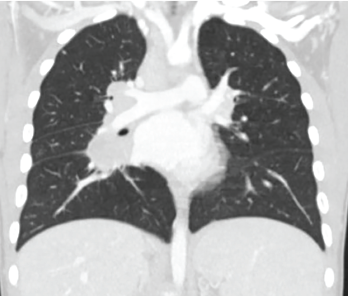
High-resolution computed tomography shows evidence of ILD.
The ACR/CHEST ILD Guidelines in Practice, a video
In collaboration with the American College of Chest Physicians, the ACR released two new comprehensive guidelines aimed at improving the screening, monitoring, and treatment of patients with interstitial lung disease (ILD) secondary to systemic autoimmune rheumatic diseases (SARDs). Recently, Sindhu R. Johnson, MD, PhD, professor of medicine at the University of Toronto, Canada, director of the Toronto Scleroderma Program and principal investigator for the guideline, and Elana J. Bernstein, MD, MSc, Florence Irving associate professor of medicine in the Division of Rheumatology at Columbia University, New York City, and co-first author, presented a webinar to talk about how the guidelines were developed and present some of the recommendations and their rationale: Watch the recording now!
The 2020 Basic Science Year in Review covered autoantibody origin and persistence, insights into the major histocompatibility complex and factors in rheumatoid arthritis progression and relapse.
Cardiovascular disease (CVD) is a leading cause of death in patients with rheumatoid arthritis (RA). Patients with RA have a 1.5 times increased risk for heart attack compared with the general population. Although the treatment of RA has advanced significantly, the ability to prevent cardiovascular events hasn’t followed. A study in Arthritis Care & Research…
Neutrophils, often hailed as guardians against infections, are maligned when it comes to rheumatoid arthritis (RA) due to their role in both the initial stage and disease progression. A new multicenter work, “A Neutrophil Activation Biomarker Panel in Prognosis and Monitoring of Patients with Rheumatoid Arthritis,” seeks to expand the literature on this topic.1 The…

Interventions targeted at mitigating the risk of preeclampsia may reduce preterm birth and cesarean delivery in women with rheumatoid arthritis (RA), systemic lupus erythematosus (SLE) and psoriasis. That’s one key finding of a retrospective study published in Arthritis Care & Research.1 The study set out to quantify the mediated effects of autoimmune conditions on adverse…

Research in The New England Journal of Medicine has opened new avenues for exploring the pathophysiology of disease flares in rheumatoid arthritis.1 Through longitudinal genomic analysis, researchers have identified a naive B cell signature prior to rheumatoid arthritis flares, as well as a type of mesenchymal cell, that may play an important role in flare…

In 2018, the Rheumatology Research Foundation embarked on its third and most ambitious fundraising campaign, the Leading Boldly: Transforming Rheumatology campaign, with a goal of raising $75 million over five years. The campaign supports Foundation programs to recruit the best and brightest into the field, train rheumatology health professionals at all career stages and support…
A large, international team of rheumatologists, geneticists, hematologists and other researchers has discovered a severe inflammatory syndrome linked to an acquired genetic mutation in the bone marrow of older men. The X-linked syndrome, they found, is caused by a somatic mutation in myeloid stem cells that hobbles the master regulator of a pathway tasked with…
Gender plays a role in career advancement among academic rheumatologists in the U.S., according to a new study by Jorge et al.

In case you missed it, on Nov. 20, the Centers for Medicare & Medicaid Services (CMS), a department within the U.S. Department of Health and Human Services, announced that it will overhaul the payment system for Medicare Part B (i.e., infusion) drugs on Jan. 1, 2021. The plan is called the Most Favored Nation (MFN)…

During ACR Convergence 2020, Jinoos Yazdany, MD, MPH, discussed innovative research into a potential treatment for lupus, medication tapering & more. These findings may influence the treatment of rheumatic disease in the future.