ACR Convergence 2025| Video: Rheum for Everyone, Episode 26—Ableism

An official publication of the ACR and the ARP serving rheumatologists and rheumatology professionals

  • Conditions
    • Axial Spondyloarthritis
    • Gout and Crystalline Arthritis
    • Myositis
    • Osteoarthritis and Bone Disorders
    • Pain Syndromes
    • Pediatric Conditions
    • Psoriatic Arthritis
    • Rheumatoid Arthritis
    • Sjögren’s Disease
    • Systemic Lupus Erythematosus
    • Systemic Sclerosis
    • Vasculitis
    • Other Rheumatic Conditions
  • FocusRheum
    • ANCA-Associated Vasculitis
    • Axial Spondyloarthritis
    • Gout
    • Lupus Nephritis
    • Psoriatic Arthritis
    • Rheumatoid Arthritis
    • Sjögren’s Disease
    • Systemic Lupus Erythematosus
  • Guidance
    • Clinical Criteria/Guidelines
    • Ethics
    • Legal Updates
    • Legislation & Advocacy
    • Meeting Reports
      • ACR Convergence
      • Other ACR meetings
      • EULAR/Other
    • Research Rheum
  • Drug Updates
    • Analgesics
    • Biologics/DMARDs
  • Practice Support
    • Billing/Coding
    • EMRs
    • Facility
    • Insurance
    • Technology
      • Information Technology
      • Apps
    • QA/QI
    • Workforce
  • Opinion
    • Patient Perspective
    • Profiles
    • Rheuminations
      • Video
    • Speak Out Rheum
  • Career
    • ACR ExamRheum
    • Awards
    • Career Development
      • Education & Training
    • Certification
  • ACR
    • ACR Home
    • ACR Convergence
    • ACR Guidelines
    • Journals
      • ACR Open Rheumatology
      • Arthritis & Rheumatology
      • Arthritis Care & Research
    • From the College
    • Events/CME
    • President’s Perspective
  • Search

Advances in Giant Cell Arteritis

Philip Seo, MD, MHS  |  Issue: December 2025  |  November 14, 2025

The latest research on imaging & treatment for GCA presented at ACR Convergence 2025
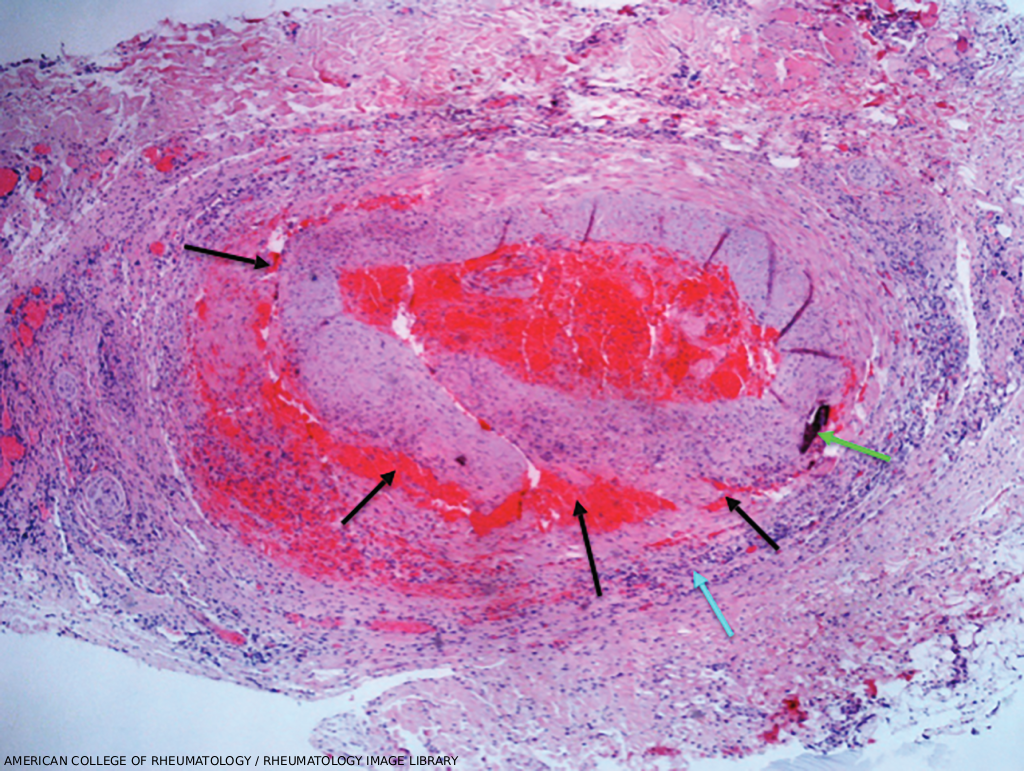
This temporal artery biopsy from a 73-year-old man with jaw claudication and acute vision loss shows vessel wall inflammatory infiltrates (blue arrow) with rare giant cells and loss of the internal elastic lamina. (Click to enlarge.)

CHICAGO—Giant cell arteritis (GCA) is the most common form of systemic vasculitis in older adults, but until recently, we had relatively little to offer patients with this diagnosis. Recent years have seen an explosion of research, leading to substantial advances in the assessment and treatment of GCA. Here, we highlight some of the most exciting GCA-related research presented at ACR Convergence 2025.

1. Efficacy & Safety of Upadacitinib

Schmidt et al., Abstract 07761

In April, the U.S. Food & Drug Admin­istration (FDA) approved upadacitinib, an oral Janus kinase (JAK) inhibitor, for the treatment of GCA based on SELECT-GCA, a double-blind, randomized trial. This study demonstrated that 15 mg of upadacitinib taken daily combined with a 26-week glucocorticoid taper was superior to treatment with a 52-week glucocorticoid taper at achieving sustained remission in patients with GCA.2

ad goes here:advert-1
ADVERTISEMENT
SCROLL TO CONTINUE

In a follow-up study presented by Schmidt et al., patients who remained on upadacitinib for an additional year had a higher sustained remission rate than patients who stopped therapy (68.6% vs. 28.6%), leading to a 90% reduction in the risk of disease flare from week 52 to week 104. Patients who remained on upadacitinib continuously for two years also required less glucocorticoids to remain in remission than patients who stopped therapy after one year. Additionally, patients treated with 15 mg of upadacitinib daily over two years had higher rates of herpes zoster and elevated creatine kinase, but lower rates of serious infection, and no increased risk of venous thromboembolism, major adverse cardiovascular events or death.1

Many clinicians have been reluctant to consider prescribing JAK inhibitors for older patients, given that the ORAL Surveillance clinical trial demonstrated a potential association between tofa­citinib and several adverse events, including venous thromboembolism and major adverse cardiovascular events.3 However, the current study with two-year follow-up data from the SELECT-GCA trial implies that long-term therapy with upadacitinib is well tolerated. This finding is fortunate because the results also indicate that many patients may benefit from prolonged drug therapy.

ad goes here:advert-2
ADVERTISEMENT
SCROLL TO CONTINUE

2. Glucocorticoid Tapering

Buttgereit et al., Abstract 08954

In another analysis of the SELECT-GCA study, investigators focused on the effect of upadacitinib on serious infections, herpes zoster and opportunistic infections.

Page: 1 2 3 4 5 6 | Single Page
Share: 

Filed under:ACR ConvergenceConditionsMeeting ReportsVasculitis Tagged with:AAV FocusRheumACR Convergence 2025ANCA-Associated Vasculitisgiant cell arteritis (GCA)GlucocorticoidsimagingMagnetic resonance imaging (MRI)taperingupadacitinib

Related Articles

    Large Vessel Vasculitis

    December 1, 2023

    SAN DIEGO—The large vessel vasculitides, including Takayasu’s arteritis and giant cell arteritis, experienced a surge of interest at ACR Convergence 2023. Here, we highlight important points from 10 of the studies presented at this conference.

    Two Inflammatory Conditions—Polymyalgia Rheumatica and Giant Cell Arteritis—Share Clinical Connection

    March 1, 2013

    Polymyalgia rheumatica (PMR) and giant cell arteritis (GCA) have common clinical and epidemiologic links, but they need not occur synchronously

    Case Report: Giant Cell Arteritis-Related Stroke

    September 10, 2023

    Thromboembolic events are major contributors to the morbidity and mortality of patients with giant cell arteritis (GCA), but little is known about how GCA may increase the risk of ischemic strokes. GCA-related stroke is described as an ischemic cerebral infarct occurring within three to four weeks of GCA diagnosis and treatment. It occurs in 3–7%…

    Updates on Giant Cell Arteritis

    March 19, 2018

    SAN DIEGO—Recent research tells us more about giant cell arteritis (GCA) to help rheumatologists more accurately diagnose and effectively treat patients with this type of vasculitis. On Nov. 6 at the ACR/ARHP Annual Meeting, three experts explored the latest findings on GCA pathogenesis, diagnostic approaches, imaging modalities and growing treatment options. GCA: What’s Really Happening?…

  • About Us
  • Meet the Editors
  • Issue Archives
  • Contribute
  • Advertise
  • Contact Us
  • Copyright © 2025 by John Wiley & Sons, Inc. All rights reserved, including rights for text and data mining and training of artificial technologies or similar technologies. ISSN 1931-3268 (print). ISSN 1931-3209 (online).
  • DEI Statement
  • Privacy Policy
  • Terms of Use
  • Cookie Preferences