ACR Convergence 2025| Video: Rheum for Everyone, Episode 26—Ableism

An official publication of the ACR and the ARP serving rheumatologists and rheumatology professionals

  • Conditions
    • Axial Spondyloarthritis
    • Gout and Crystalline Arthritis
    • Myositis
    • Osteoarthritis and Bone Disorders
    • Pain Syndromes
    • Pediatric Conditions
    • Psoriatic Arthritis
    • Rheumatoid Arthritis
    • Sjögren’s Disease
    • Systemic Lupus Erythematosus
    • Systemic Sclerosis
    • Vasculitis
    • Other Rheumatic Conditions
  • FocusRheum
    • ANCA-Associated Vasculitis
    • Axial Spondyloarthritis
    • Gout
    • Lupus Nephritis
    • Psoriatic Arthritis
    • Rheumatoid Arthritis
    • Sjögren’s Disease
    • Systemic Lupus Erythematosus
  • Guidance
    • Clinical Criteria/Guidelines
    • Ethics
    • Legal Updates
    • Legislation & Advocacy
    • Meeting Reports
      • ACR Convergence
      • Other ACR meetings
      • EULAR/Other
    • Research Rheum
  • Drug Updates
    • Analgesics
    • Biologics/DMARDs
  • Practice Support
    • Billing/Coding
    • EMRs
    • Facility
    • Insurance
    • Technology
      • Information Technology
      • Apps
    • QA/QI
    • Workforce
  • Opinion
    • Patient Perspective
    • Profiles
    • Rheuminations
      • Video
    • Speak Out Rheum
  • Career
    • ACR ExamRheum
    • Awards
    • Career Development
      • Education & Training
    • Certification
  • ACR
    • ACR Home
    • ACR Convergence
    • ACR Guidelines
    • Journals
      • ACR Open Rheumatology
      • Arthritis & Rheumatology
      • Arthritis Care & Research
    • From the College
    • Events/CME
    • President’s Perspective
  • Search

Search results for: pediatric

University of Alabama at Birmingham’s Division of Clinical Immunology & Rheumatology Recognized for Excellence

Gretchen Henkel  |  June 13, 2016

An interdisciplinary and collaborative environment is a critical factor for the advancement of basic science and clinical research in the academic environment, says William J. Koopman, MD, former director of the University of Alabama at Birmingham’s (UAB’s) Division of Clinical Immunology and Rheumatology. And in 1977, when he was being recruited by Division Director J….


Filed under:ConditionsPediatric ConditionsProfessional TopicsProfilesResearch Rheum Tagged with:CareerexcellenceImmunologyPediatricProfileResearchrheumatologyUniversity of Alabama at Birmingham

Find Your Mentor in Medicine

Karen Appold  |  June 13, 2016

Medicine has traditionally been an apprenticeship model. The most elemental and constructive method of passing on knowledge is the mentor–mentee relational experience. Mentorship encompasses not only the role of teacher, but also that of coach, role model, advisor and confidante. Matthew J. Koster, MD, rheumatology fellow and instructor in medicine, Mayo Clinic, Rochester, Minn., can…

Filed under:Career DevelopmentProfessional Topics Tagged with:Career developmentMentorresidentrheumatology

Email Remains Dominant Communications Method in Medicine

Richard Quinn  |  June 13, 2016

Forty-five years ago, a computer engineer in Boston sent an electronic message between two computers some 10 feet apart. It took another 10 years or so before the electronic mail message was dubbed email—a term now, perhaps, more ubiquitous than any other in the lexicon of modern communications. Despite the seemingly definitive place email communication…

Filed under:Practice SupportProfessional TopicsTechnology Tagged with:communicationemailFacebookGoogleHIPPAITpatient carephysicianprivacyrheumatologistSecuritySocial MediaTechnologyTwitter

Biomarkers Differentiate Crohn’s Disease from Ulcerative Colitis

Marilynn Larkin  |  June 4, 2016

NEW YORK (Reuters Health)—Newly identified biomarkers could aid in the diagnosis of inflammatory bowel disease (IBD) and help guide therapy, Canada-based researchers report. Accurately differentiating between Crohn’s disease (CD) and ulcerative colitis (UC) is important for ensuring early and appropriate treatment. However, the conditions can’t be reliably distinguished based on clinical symptoms, site of disease,…

Filed under:ConditionsOther Rheumatic Conditions Tagged with:BiomarkersChildrenCrohn's diseaseinflammatory bowel diseaseulcerative colitis

Rheumatology Drug Updates: Infliximab Biosimilar Gets FDA Approval & More

Michele B. Kaufman, PharmD, BCGP  |  May 13, 2016

April 5, 2016, marks a revolutionary day in the treatment of autoimmune diseases: The U.S. Food and Drug Administration (FDA) approved an infliximab (Remicade) biosimilar, known as Inflectra (infliximab-dyyb). Infliximab-dyyb, which is administered by intravenous infusion, is the first biosimilar drug approved to treat rheumatic disease in the U.S.1 Infliximab-dyyb has received approval for almost…

Filed under:Biologics/DMARDsDrug UpdatesResearch Rheum Tagged with:ApprovalsBiologicsBiosimilarsdrugFDAInflectrainfliximabRemicadeResearchrheumatologySafetyZirletta

Tips for Setting Treatment Goals with the Patient

Karen Appold  |  May 13, 2016

When working with a newly diagnosed patient to determine a treatment plan, ensure the patient has a good understanding of the diagnosis, the options available and what the options entail. “It is important to help patients understand that there are choices, and that their decisions should be based on what matters to them,” says Susan…

Filed under:Practice SupportQuality Assurance/Improvement Tagged with:patient carerheumatologistrheumatologytreatment goals

Why Physicians Say Sick Days Aren’t Worth the Trouble

Karen Appold  |  May 13, 2016

A recent JAMA Pediatrics article found that 83% of clinicians admitted to coming to work while sick and 95% admitted to knowing that it could be dangerous for their patients.1 “The decision to work sick is shaped by systems-level and sociocultural factors,” the study authors wrote. In speaking with rheumatologists on the matter, I found…

Filed under:Practice SupportWorkforce Tagged with:PhysiciansPractice Management

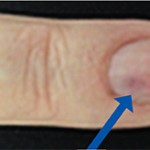
Figure 2: The nail bed shows some discoloration.

3 Cases of Glomus Tumor—An Unusual Cause of Hand Pain

Abraham Chaiton, MD, MSc, FRCPC, RhMSUS, & Maggie Larché, MBChB, MRCP, PhD  |  May 13, 2016

Hand and digit pain are common presenting symptoms to primary care physicians, rheumatologists, physiatrists and neurologists. There are many causes, but quality and location of the pain can be important clues to the diagnosis. Glomus tumors, neurovascular hamartomas of the glomus body, are an uncommon cause of hand pain. The glomus unit itself is a…

Filed under:Conditions Tagged with:Diagnosisglomus tumorhand painrheumatology

State of RheumPAC: 2015 Annual Report

Harry L. Gewanter, MD  |  May 13, 2016

Dear Friends and Colleagues, With your strong support and commitment, RheumPAC has grown again for the eighth straight year, allowing us to do even more on your behalf. Not only did we exceed our original goal by raising more than $150,000. More importantly, these donations came from nearly 350 ACR and ARHP members—a new record….

Filed under:Legislation & AdvocacyProfessional Topics Tagged with:AC&RAdvocacyAssociation of Rheumatology Professionals (ARP)rheumatologistRheumPAC

From the Expert: Dr. Anne Bass Addresses Fellowship Training in Rheumatology

Richard Quinn  |  April 29, 2016

As the need for specialists increases, the Rheumatology Fellowship Program at HHS seeks to grow the number of practicing rheumatologists. Program Director Anne Bass, MD, discusses the program’s ideas behind funding rheumatology fellowships and the challenges of attracting medical students to the field…

Filed under:Career DevelopmentEducation & TrainingProfessional Topics Tagged with:FellowsfellowshipHospital for Special Surgery in New YorkrheumatologistrheumatologyRheumatology Fellowship ProgramTraining

  • « Previous Page
  • 1
  • …
  • 76
  • 77
  • 78
  • 79
  • 80
  • …
  • 112
  • Next Page »
  • About Us
  • Meet the Editors
  • Issue Archives
  • Contribute
  • Advertise
  • Contact Us
  • Copyright © 2025 by John Wiley & Sons, Inc. All rights reserved, including rights for text and data mining and training of artificial technologies or similar technologies. ISSN 1931-3268 (print). ISSN 1931-3209 (online).
  • DEI Statement
  • Privacy Policy
  • Terms of Use
  • Cookie Preferences